History:
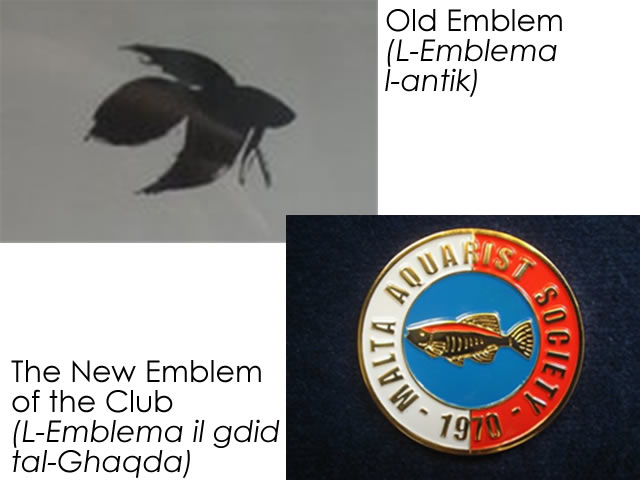
The Society was established in the year 1970 by a small group of aquarists with the aim of expanding their hobby in the Maltese Islands. The first few meetings used to take place at the aquarists’ own place, during which time the society started increasing its members tally. After overcoming a number of difficulties, we can presently state that it has rooteditself as the local national society for aquarists thus the name THE MALTA AQUARIST SOCIETY. Also, it had become more knowledgeable by associating itself with foreign clubs, such as the Association of Aquarists and the Federation of British Aquatic Societies. After some time the Malta Aqauarist Society obtained also a premises where it could dedicate most of it's work as well as an official meeting place where to hold meetings, committee elections, discussions as well as trading of locally bred fish (by the members themselves)
|
|
Buzaqq (Aphanius fasciatus):
It was once a common fish in the Maltese islands but know is under threat of extinction in the waters. It is one of the protected species here in Malta which cannot be caught, bought nor kept. Both sexes of Aphanius fasciatus will grow to around 6 cm in length. The females have a pattern of black spots and lines along the side of the body. On young fish it can be hard to tell males from females because males has the same black spot pattern until they mature and get their yellow fins and blue/grey body colour with bright lines. However, from that point on it's easy to tell them apart. The breeding season is concentrated around the hot summer months of June, July, August and perhaps as late as the beginning of September if the temperature is high enough. A. fasciatus is not easy to breed as it needs space and in the wild there are several other factors mainly predators feasting on the fish, fry and eggs of the A. fasciatius.
|
 |
|
The growth rate of newly hatched A.fasciatius is rather slow, especially during winter where the size of the fish seems to sort of stop. From Febrauary till summer the growth will seem to explode at a very fast rate and will become mature within a short period of time. This is done so as to be fully amture and ready to breed in the following summer or else in the hottest months June, July ,August and September.
In the past, Aphanius fasciatus used to live in 4 principal localities, being Marsaxlokk, Wied il-Ghajn, Marsa and at Salina. The latter used to be the largest saltpans on the island.
But in all the localities several mishaps or evolutionary paths led for the eradication of the A.fasciatus. Taking for example Marsaxlokk where In the `50, the locality at Marsaxlokk where the fasciatus used to live, was dredged up to provide a haven for the fishing boats and the fasciatus disappeared for here for ever.
Many people recall that In the 80's, the Canal at Marsa, there was the best population. It used to produce the largest and most colourful variety from all 4 localities ,here the fasciatus were eradicated too. The main reason was that the Bottom of the Marsa Canal was full of crevices from which the A. fasciatus could find shelter. Apart from this an algae growing in great abundance provided a good source of food for the fish. But unfortunately concrete was set killing both the algae and fish and an abattoir was built not so far that pumped high volumes of highly salinated water into the Canal.
In the Salina Area, the same issue happened, due to pollution and in the beginning of the 90's a Fish Farm was set up in the exact location where the A.fasciatus used to live thus eradicating any sign of the fish.
The only places left with A.fasciatus are the Maghluq in Wied il-Ghajn, There are some specimens alive but it is very difficult to actually go there and see. This area is polluted and therefore a limited number still survive and healthy.
In the Mid 1980's The Birdlife and the Malta Natural Society introduced the Aphanius fasciatus in several natural reserves. This project was successful and the fish seems to like it. The only problem is that being endangered if something happens to these nature reserves then the Buzaqq will be extinct from Malta. Although the Buzaqq can thrive in both freshwater and saltwater but the natural reserves are a locked down and the fish cannot migrate to other areas.
Many books describe the decline of the A. fasciatus as a result of the indiscriminate collection of this species by aquarists and enthusiasts. The Malta Aquarist Society those not agree on such accounts because the A. fasciatus become very stressed when caught and might not survive due to their stressful condition. Apart from that the fish is a seasonal fish therefore in winter it must be kept in cold water conditions or else it will not survive.
Our Aim:
The main aim of our society is to pass on to its members the knowledge and experience acquired along time. This way, the members will advance and specialize furthermore into the hobby, with great satisfaction for him and fellow members. It is a very nice experience to have an aquarium to stare at whenever you pass near, but to actually know what is best for your fish, knowing their roots and most of all knowing that they are healthy and happy is another thing. We are constantly searching for new information; new ways how to have the utmost from our fish and in the meantime keep them as similar to their natural habitat. With knowledge at hand both the aquarist as well as the fish will be happy and thus hobby will remain strong and alive in oneself.
|
|
